Showing posts with label TheSun. Show all posts

Monday, November 19, 2012

The Story Of Deepavali

Deepavali had just passed. To celebrate this occasion theSun run picture story on one of the mythologies behind the celebration. On the front page of the Sun, on the eve deepavali ( Nov 12), we had a picture of a dancer in a multi exposure. ( like below) 


Then on the page 19, we run a picture story of how the evil King Narakasura was defeated which also marks the triumph of good over evil ( like below   


I would like to thank The Temple of Fine Arts for agreeing to do this photo shoot. Many thanks to the sun photographers Syed Azhar Syed Osman and Norman Hi who put their sweat and blood into this project. Now for the full story 


Headline: The story of Deepavali 
By Bissme S 
PIX BY SYED AZHAR SYED OSMAN AND NORMAN HIU/THE SUN

TOMORROW, Hindus all over Malaysia will becelebrating Deepavali, also known as the Festival of
Lights. There will be rituals to follow such as taking an oil bath, prayers to be said, putting on new clothes and preparing delicious food like ladoo, jalabi, murukku, mysore pak and adhirasam to be served to family, relatives, friends and guests who will be visiting them.
To celebrate this festival, theSun invited five dancers from the Temple of Fine Arts to tell in dance form the most popular mythology associated with the origin of this festival – the tale of King Narakasura who was corrupted by power and was in the end defeated by Lord Krishna and his wife Satyabhama in a
triumph of good over evil.


Scene 1
King Narakasura (played by PremSagar Krishnan, 23) has been praying and meditating for many years.

Scene 2
From heaven comes Lord Brahma (Nageshwaran Ramachandran, 13) to bless King Narakasura. Lord Brahma says to him: “I am impressed with your prayers. You can ask me for any thing you want.” Narakasura asks that no one can kill him except his mother,
Bhuma Devi (Printha Selvadurai, 20).


Scene 3
Knowing that no mother can kill her own flesh and blood, Narakasura becomes corrupted by absolute power. For years, he rules his kingdom with an iron fist bringing terror and misery to the people

Scene 4
Up in heaven, Lord Krishna (Pankhuri Agrawal, 21) and his wife Satyabhama (Swathi Sivadas, 21) hear the cries of the people. Lord Krishna says: “I have to save the people.” So war is declared between Lord Krishna and King Narakasura.

Scene 5
Lord Krishna is wounded in the battle. Satyabhama is furious and vows to kill Narakasura, who replies arrogantly that no one can kill him except his mother.

Scene 6
Satyabhama manages to defeat Narakasura who begs for his life. But she shows him no mercy and kills him.

Scene 7
Narakasura realises that Satyabhama is the reincarnation of his mother Bhuma Devi and that’s why she could defeat him. He breathes his last on his mother’s lap. He tells Satyabhama: “Do not cry mother. You have done the right thing to kill me as I have been evil. I’m glad to have you as my mother.” Showing regrets for being an evil king, Narakasura says that his death should be celebrated as a victory of light over darkness and the triumph of good over evil.

Scene 8
Because Narakasura has repented forhis evil deeds, he becomes a celestial being after his death. He then seeks blessings from both Lord Krishna and his wife Satyabhama.

Sunday, October 31, 2010

Kam Raslan


Who ever said local writer cannot produced good work. Then they have not read Kam Raslan's Confessions of an Old Boy - The Dato' Hamid Adventures. I had opportunity to interview the author. His story appears in the sun Aug 2 , 2007
The artist as iconoclast
Bissme. S
It's not easy to write humour, but that is what writer/director Kam Raslan does with panache. Publisher Marshall Cavendish (Malaysia) is considering submitting his book Confessions of an Old Boy - The Dato' Hamid Adventures to be nominated for the Impac Dublin Literary Award. The book centres on a retired civil servant who looks back on his life from the 1940s, taking the reader from Kuala Lumpur to Monte Carlo, Los Angeles to Algiers and London. Kam talks to BISSME S. about the book, stereotypes, rewriting history, his frustration as an artist in Malaysia, directing a feature film, and his search for father figures.

theSun: Every writer has a message to convey. What is yours?
Kam: One message was to break down the Malay stereotype ... help to remind us that there are different types of Malays. And once upon a time, my character - an anglophile Malay, an aristocrat - would actually have been defined as the archetypal cliche of the Malay if we had gone back 50 years.
Over time things have changed. There has been the rise of the "working class Malay" led by the likes of (Tun) Dr Mahathir (Mohamad). That is fine.
In the process, these Malays have been scrubbed from history. It is almost an embarrassment to their history. I want to reclaim these people. I want to bring these guys back into public memory.

Why bring them back?
Because when I speak to many non-Malays, they remember these people with affection. They (non-Malays) feel these guys were just like us ... they did the same things together ... saw the world in the same way ... spoke the same language literally.
The people in his (Dato' Hamid's) generation have been through so much. They have lived through so many moments in history ... to be born under the flag of the British Empire ... living through the Japanese Occupation during the war and seeing their British masters run away ... at a fairly young age creating a new country ... governing a new country. My father was one of those people. He came back to Malaysia after having been in London for many years.
I want to remind people that people had lived lives in this country that were very exciting and very interesting ... bigger than walking around the shopping mall and choosing a new Gucci bag ... bigger than choosing a new handset.
When you remember that, you will realise that not only have these people lived this wonderful life, this country has a more interesting history than people it give credit for.

Did you receive any threats, especially death threats, when you had your character Dato' Hamid referring to his son, a politician, as the Ayatollah?
I am one of the few writers in this country who have not yet received a death threat. (laughs)

Is that good or bad?
I think a death threat is good for sales. The fellows who read my book and spoke to me - they identify more with the Dato' than his son, the Ayatollah. It might be that they are with Ayatollah but they want to be like the Dato'. Maybe there are people out there (who want to kill him), but they have not said anything to me.

Is the character of the Ayatollah a reflection of the people running this country?
The people who are running the country are the children of the same elite. They still have the same sensibilities. They still enjoy a good cigar and probably have a good whisky ... I don't know ... I can't say for sure. They still share the same tastes. But that is private. In public though they now dress in different clothes. They have to speak to different and wider audiences. So they put themselves over as being the opposite of their father's generation. Those are the people who are running the country and the ones below them, that is a different story.

Tell us about a chapter in the book that you loved?
Hamid goes to his son's house and he sees there are no books, but there is an incredibly long dining table. I have been in many of those houses. One of the saddest things about those houses is that the kids are locked up in their rooms with their Internet, checking out chat sites all over the world. That is a monolithic and rather dull cultural image. It is not really remembered now, but an essential part of the Malay culture is to travel. I hear stories of young guys who got on a ship and sailed off and ended up in San Francisco, London and Paris. I have even met some of them.

Are there any similarities between the character of Dato' Hamid and you? And differences?
He doesn't believe in anything. But I do believe in some things. He wants the quiet life and I am not so keen on a quiet life. He loves his luxuries and I love mine too. He can't afford them, neither can I. He has seen more than I have.

There is a hint of the anti-establishment sentiment in your writing. Are you?
I wouldn't say I am anti-establishment. I was born into the establishment. I am anti-rewriting of history in ways I think that narrow the Malaysian imagination. I am anti-inefficiency. I am anti people not being given a fair chance.

Can you elaborate on "rewriting Malaysian history"?
I will give an example. I have a painting on my wall which I cut out from an old British newspaper (1870s). It has a bunch of Malay warriors charging at uniformed British soldiers who are shooting at them. It was the Perak War in 1876. In a way, that image describes me because I am half British and half Malay. That is my Malay side charging at my British side.
But the thing is that the story is not that clear cut. My forefathers were not those Malay fellows charging. They were on the other side and they benefited. They weren't necessarily Pro-British but they were just one faction vying against another.
My mother's family (Kam's British side) is very working class and I am not a member of the ruling class there. I have a working class British background but I led a very middle-class life.
The point I am making is that when I see images of history portrayed in very simplistic terms, when people say that the Malay warriors were charging at British soldiers and we must celebrate, I will say it is too simple.
If you ask me to look at the real background, it is much more complicated and much more interesting. It actually helps to describe who and what we are - we stop being two-dimensional characters and become three-dimensional.
I do not like rewriting history. I like us to be honest in the way we understand our history.

So you think we rewrite history?
I think we do. I remember watching the TV one Merdeka and there was a Malaysian guy who was saying it is really great to celebrate the sacrifices the freedom fighters made. I thought, "who is he talking about?"
One of the great things about this country is that we negotiated our independence. I have been getting the impression that there is a passive rewriting of history that our independence was fought for. Fighting for it suggests guns and guerilla ambushes.

Would you want to turn your book into a movie?
No. It is un-cast-able. The budget is too big. Everyone who reads the book, they are the film directors, they are directing that movie, they can hear it the way they want to hear it and they can see it the way they want to see it. If someone comes along and gives them an official image, they will be disappointed.

You said you always wanted to direct your first feature film. Why haven't you done so?
I had an offer to do a romantic comedy. I like the genre, but I wanted to do something that grips me. I grew up watching the likes of The Godfather. Not that I want to do The Godfather - it has already been done. I am gathering the strength to do it.

Do you have a story idea for your first feature film?
Yes. It is set in Kuala Kangsar in 1917 when a young man returns from Al Azhar University in Egypt. These days we think of Al Azhar as being a potential breeding ground for militant Islamists.
Back then, it was seen to be a place for secular and progressive western ideas. He comes back with modern ideas and comes into conflict with his father who is very much old school of adat (tradition) and working with the Istana (palace).
My hero is found guilty of a crime he didn't commit, and gets away with a crime he did commit. It is so huge and requires so much of money.

Why not start with small films like Yasmin Ahmad and Amir Muhammad have?
You are absolutely right. There are many stories but I never felt confident enough before. Now I have seen Sepet and said to myself "Oh yeah, I know these guys and I could have done that". I think what Amir and Yasmin are doing is fantastic. In fact I am a big fan of Afdlin Shauki.
I will direct my first film when I start getting my proposal together, and start writing my synopsis, and start knocking on the door of the rich and powerful who will sign me a blank cheque.

Which are you more passionate about - going behind the camera as a director or sitting down to write?
It's funny: I enjoy both, I hate both. Directing is getting up really early every day for weeks and constantly having to have an opinion on everything. It is not nearly as creative as you imagine.
The down side of writing - it is lonely, boring and unhealthy. You never move, you just sit there and you smoke.
The good thing with movie making - you have the opportunity to get out and be among so many people. It's exciting when you are making it happen. It's a hell of a thrill - making the sequences come together and the actors giving more than you imagine.
The good thing about writing is that I don't have to think about a budget and constraints like censorship.

Do you think there is less censorship in writing?
There is in a sense. In book publishing, you can say quite a lot. You go through the shelves in any bookshop in the Malaysian section and you can find many very interesting and surprising voices.

What are the changes you like to see taking place in this country?
I really want that one day for all 25 million (of the Malaysian population) to be able to take part in important things ... for everyone to have the tools and the ability to be the CEO ... to be the chief editor of a newspaper ... to be a contributor to our future. Now, because of various policies, we have many people in this country who cannot perform certain functions.

What is the biggest limitation you face as a writer and director in Malaysia?
The creative arts and entertainment in this country are not well paid. Maybe it is because we are not a terribly rich country.
I find that when I get involved in a TV project, it is not considered an important priority to pay people like us.
The way I see it, the people who are creating works that are actually generating an audience should be paid. Instead the priority in this country is the manager. He is considered more important that the creator.

Can you give an example?
Just this morning I went to a production house to talk about a script. The man who owns it has been in the TV industry for 30 years and he has to close his place down. He can't pay his staff. He simply can't get a commission from the TV stations. After generating programmes that were the most popular thing on TV, he has to close down. He's a good guy and played by the rules but he is being passed over. For the creative artist who wants to do something, that is the problem. It is a system that doesn't encourage people to come along and create stuff. The system doesn't exist to recognise these people.

Is that one of the reasons you plan to go back to England to try your luck as director and writer?
Yes. It is tough for me because I know I am good at what I do. It sounds incredibly arrogant. Sometimes I find myself in a situation where I am talking to people who have the ability to make my dream come true.
I say to myself that you are so stupid and I am so talented and don't you understand how it is supposed to work around here? I walk out of the room and it didn't happen. At least if I go to England, I will be tested. I just feel I need to go off and achieve something somewhere else, just so I can come back and prove to people that I am actually capable of doing what I said I was.

Is it frustrating being an artist in Malaysia?
You tell me. How many artists have you interviewed over the years who have said it is not frustrating to be one.

Do you believe writing can change the world? Do you believe your book has changed anything?
We kind of harbour that illusion. But at the same time we can't help it. I've got no choice. I need to do this. I can't turn my back on it (writing).
I would love for a book to change the world. But I don't think that any more. I used to believe that could happen.
If someone read my book and agreed with something in there and said, "I must now do this", it is because of all the other things happening in their lives. It is also because they already believe in that. It is just that my book might have given it a voice and put it into words. I don't think it is possible for one thing to come along and do that.
I love the book, but it is not Martin Luther King Jr standing and saying "I have a dream and let us walk hand in hand". It is not Mahatma Gandhi's salt march.

Tell us about your childhood years and how they have influenced you?
You are not my analyst (laughs). My father died when I was five (Kam was in Malaysia at the time). My first five years were very privileged ones. Suddenly I was taken to England, we weren't dirt poor, but we just suddenly landed in a middle class environment. I was so young and not so conscious of it.
I grew up in an English environment, but I was always aware of being a Malaysian. I would always tell my friends I was Malaysian.
I guess on a psychological level, I was affected by the dislocation and shock that something could be taken away. I am not talking about material things but the fact that my father suddenly disappeared.
I was the youngest of three siblings and looked up to my two brothers. My eldest brother was only 11, and he suddenly had to play a role that he could barely comprehend.
Growing up without a father figure meant I was always looking for father figures and creating them. In a way, with Hamid, it is no surprise that I should feel so at home writing about a guy who is my father's age. But he is not like my father. I have been drawn to seeking out these father figures and at the same time rejecting them. I must say that the biggest single influence of the whole experience is that I really raised myself intellectually. I didn't learn to understand the world around me by asking what that is and how is it that works like that. But I happened to work it out through discussion with my other six-year-old friends. It has given me an enormous sense of independence.

What one piece of advice would you give budding writers?
Don't do it. It's too hard. I would not wish it on my worst enemies. I can get by but I can't see myself making a pensionable future. If my words mean nothing to you, then learn the art of writing ... learn the techniques of writing. Concentrate on it to the exclusion of all other things, and most importantly, live life with your eyes and ears wide open. If you don't live life, you will have nothing to write about.

Saturday, October 23, 2010

Lim Swee Tin


Here is an interview that talks about bringing Malay literature to the international level to the point of winning nobel prizes.The article appeared in the sun dated Jan 3 2008
Title: Global Malay writing

Bissme S.
Lim Swee Tin is one of only a few non-Malays who wax lyrical in Malay, even writing books in the language. Of Chinese-Thai parentage, he has been writing for 37 years and has won more than 20 awards, including the SEA Write Award from Thailand and the Perdana Literary Award. the prolific writer has produced 18 books of poems, seven novels and over 20 short stories. Some of his poems have been translated into English, Russian and Korean. Lim, 55, has been invited to recite his poems in Thailand, Taiwan and Britain. A literature lecturer at Universiti Putra Malaysia, he also sits on the national language committee in the Education, and Arts, Culture and Heritage ministries. Lim laments to BISSME S. about the dearth of good literary works in Malay and how Malaysians do not read. Nevertheless, he dreams of seeing a Malaysian win the Nobel prize for literature.

theSun: Why do you think there are so few non-Malays in the Malay literary scene?
Lim: Sometimes the non-Malays feel an inferiority complex. Some of them feel that their work will not match that of the Malay writers. Frankly speaking, they (non-Malays) should not have this attitude. They should feel confident about their talent and their work. After all Malay is not a strange language to us anymore. It has been incorporated into our school system for years.

Some say discrimination exists, so a lot of non-Malays are not keen to write in Malay. Is this so?
I do not think discrimination exists. I am a good example. Dewan Bahasa dan Pustaka (a government body that promotes Malay literature) has been publishing my work since 1985.

People say you are the perfect example of discrimination. You have been writing for more than 30 years yet you have not received the Sasterawan Negara (national laureate) award. So far, no non-Malay who has written in Malay has received this award.
I have a hope to get it. I have a dream to get it. I feel I have given a lot to Malay literature. The award is a recognition of your contribution and your sacrifices. If I get it, I will not reject it (laughs). It will be a thrill to be called Sasterawan Negara. I do not think I am being discriminated against. There are many writers out there who are more deserving than I.

What changes would you like to see taking place in the Malay literary scene?
In recent years, I have found the Malay literature scene stagnant. There has not been much progress. Our literature is far behind that of the (rest of the) world. We need to shake things up so our literature scene will move at a fast pace and we will catch up with the rest of the world.

But some Malay novels have been selling more than 200,000 copies. Isn’t that a good sign?
I agree that the popular commercial literature is doing very well. But not the serious Malay literature.

Why do you think serious Malay literature lags behind literature in other languages?
We are stagnant in terms of new ideas. And it is not enough just to have new ideas. It is also important to present these new ideas in a way the world’s readers can relate to them. It also boils down to your writing technique and presentation.
Malaysian writers writing in English such as Tash Aw (Harmony Silk Factory) and Rani Manicka (The Rice Mother) are on the right track. They have somehow perfected the art, presented their ideas so world readers could relate to them. It is not surprising that western journals feature them and their books. At the same time, I also find there are not enough writers producing serious Malay literature. We can count them on our fingers. One particular young writer I am really impressed with is Faisal Tehrani. I see a lot of potential in him.

Why do you think there are very few writers producing serious literature compared to popular fiction?
In the last decade or so, we have sort of neglected churning out a new generation of writers in serious literature. In the past our writing associations and government bodies had many contests and programme to encourage writers to dabble in serious literature.

Some say it is not profitable to write serious literature compared to popular literature. Do you agree?
Yes. In popular fiction, a writer spends three to six months on a book. Then he sells more than 100,000 copies. The high volume will guarantee a high royalty. But in serious literature, a writer may spend several years on one novel and the sales volume is nothing to shout about. So it can be very discouraging to write serious literature.

What are the first steps we should take to encourage young writers to produce serious literary works?
For starters our serious literature needs to be translated into English and many other languages and sold worldwide. When you have the world market, the sales volume will be higher. Slowly the western journals will feature these writers.
I will give one example of a writer from China called Wei Hui. Two of her books Shanghai Baby and Marrying Buddha have been translated into more than 20 languages and sold millions all over the world. The western media also featured her. She is only 23.
The same thing should be happening to our authors who are writing serious literature, for example Faisal Tehrani. When people see local authors of serious literature doing well, more will be tempted to write serious literature.

Some believe the themes Malay writers choose are very national and Malay culture-orientated so it is not easy to translate their books and sell them worldwide. What do you say?
It doesn’t matter what theme you choose. It doesn’t matter what culture you choose. You can choose to write about a Malay fisherman in a village. But you must be able to write it in a way the world could relate to. One good example is Indonesian writer (the late) Pramoedya Ananta Toer. He wrote about situations in Indonesia, yet readers all around the world and of different cultures could relate to his stories. His books are well known all over the world.

There is less effort in translating our literature books into English; therefore the Malay books can’t travel to the overseas market easily. Do you agree?
Yes. We need to translate more of our books into English and other languages so they will be more marketable overseas. But translation is a minor reason. What we really need is the support and people who have the experience to distribute and market our books to overseas markets.

Is the government, especially Dewan Bahasa dan Pustaka, doing enough to promote our books overseas?
We cannot only depend on the government and Dewan Bahasa dan Pustaka in this matter. Big groups such as MPH can take our serious literature to the world. It (MPH Bookstores) has the resources, the network and most of all, the experience to take our literature to the world. One company I really respect is Silverfish. In the last few years it has taken the initiative to organise international literary seminars and invited well-known writers from all over the world to participate. Indirectly their seminars give exposure to local writers to improve their knowledge and to promote their books.

Is Dewan Bahasa dan Pustaka doing enough for Malay literature?
It is doing its best. But there is still room for improvement. Almost every year, Dewan Bahasa dan Pustaka has a booth to display our books at the Frankfurt Book Fair. Publishers all over the world come to this fair to buy and sell copyrights. But so far we have not heard of any outcome.

What kind of role do you think the government could play in promoting Malay literature?
The government could give grants to writers to attend writing seminars overseas. It is so difficult for writers to get any kind of grant. When a writer travels and attends writing seminars overseas, he meets a lot of people and he broadens his mind and his horizon. It will make him a more experienced writer and this will be reflected in his future work. If the government can send a man to space, why can’t we send a writer to a writing seminar in Spain or Germany?

What is your hope and dream for the Malay literary world?
I would love to see our literature reach world level and win a Nobel prize. I hope this dream will not remain a dream.

Do you think our literature has the potential to be nominated for the Nobel prize?
Yes, it has. I have read many works of Nobel prize winners and I really believe Sasterawan Negara (national laureates) such as A. Samad Said and Shahnon Ahmad have the potential to win this award. A. Samad Said’s Salina would have made a perfect nomination.

So why haven’t we walked this road?
It is not easy to get a Nobel prize nomination... it is a different ball game. First, someone has to nominate your work. This someone must be a scholar of literature and must be well-known worldwide. The Nobel prize committee will then check on the background of the person who nominates the writer ... (also) the background of the writer who is nominated.
So the first thing we should do is to translate our books into many languages and promote them in the world market. Then a scholar of high reputation will be able to see these works. When the scholar is impressed with the work, he or she will nominate it. But how many of our books have been translated into English and other languages? How many of our books have we sold overseas? But it is not too late for us to do that. We have young writers such as Anwar Ridhwan whose work we can promote to the world and still win a Nobel prize.

These days the education ministry is giving more preference to the English Language. Some Malay writers view English as a colonial language and we should not promote it. What do you think?
I do not see anything wrong with what the education ministry is doing. English is important. It is spoken worldwide. If we want to gain knowledge about the world, it is important we master English. My only hope is we do not neglect our Bahasa Kebangsaan (national language). There should be continuous development of Bahasa Kebangsaan.

Some serious novelists don’t like popular commercial literature. What is your stand on this form of literature?
I do not see anything wrong in writing about romance and youth-orientated themes. It still takes effort and energy to write what they write. The best thing is society loves reading them. Indirectly these writers are creating a reading society.
Our society is not a reading society and I support any attempt to promote reading. I believe, with time, these readers might want to graduate from reading only romance and youth themes. They may start looking at serious literature.

Why do you think ours is not a reading society?
We live in a time when people want instant gratification. Reading improves you intellectually. It shapes your personality. But you do not see instant results. It takes time before you see the effects of reading in your life.
So people prefer to spend their money and time on things where they see fast results. For example, if they go to a movie, when the movie ends, they will feel some kind of excitement.

Some say books are very expensive here so people are put off buying them. Do you agree?
I do not agree with that. Going on a date to see a movie is more expensive than some of the books. But people still go on dates and see movies. Why? Once again, they get instant gratification.

What can we do to inculcate the reading habit in our society, especially among the youth?
I remember when I was a kid, way back in the 60s, there were always vans coming to our kampung to sell books. They also buy back old books. People are too lazy to go to the bookshop. So why don’t we bring the bookshop to them?
Let us send these vans everywhere, from the housing estates to fancy condominiums. Who knows, that may spark an interest in reading again. Often we see vans going around collecting old mattresses and selling new ones. Perhaps it is time we see vans that sell books.

Your advice for budding writers?
A writer must always seek out knowledge. You will not be able to write a good novel if you do not have in-depth knowledge. So you must read a lot. You need to attend a lot of seminars. Not only literary seminars.
Attend any kind of seminar – from AIDS seminars to economic seminars. All these seminars will make you more knowledgeable.
Of course, you also need to travel. When you travel, you meet a lot of people and you see a lot of different things and all this makes you knowledgeable. All this knowledge will add substance to your writing and that will definitely impress your readers and critics.

Tell me something about yourself. What sparked your interest in reading?
I was born in Bachok, Kelantan in 1952. My father was Chinese and my mother was Thai. I speak Hokkien, Mandarin, Thai and mostly Malay. I always find myself expressing the best in Malay.
My father ran a small coffee shop while my mother was a housewife. My father had never gone to school. But he loved reading. He loved to tell his children the stories and articles he had read. I think that is where I got my reading habit.

Sunday, October 17, 2010

Faisal Tehrani


I have heard so much of the writer Faisal Tehrani. So finally I meet him in 2008 for the first time and did an interview with him and the story appeared in the sun in July 31 2008.


Title : Writing for change

Faisal Tehrani, 34, is a rising star in the literature scene. This novelist has won prizes and awards, including the prestigious Anugerah Seni Negara in 2006. His kind critics predict this talented writer, whose real name is Mohd Faizal Musa, is a national laureate in the making. Others say his writings are Islamic extremism, anti-West and are ultra-nationalist. He speaks frankly to Bissme S. about his controversial image, early days as a writer of erotic literature and the future.

Tell me your start as a writer.
I became a writer when I was 16. Dewan Bahasa dan Pustaka (DBP) had this programme Minggu Penulis Remaja. They pulled out a few potential writers from different schools and started giving us writing lessons.

Did you always want to be a writer?
When I was young, I wanted to be a writer for the wrong reasons. I wanted to show off to my friends and tell them: ‘I can write ... what can you do?’ I was also earning good pocket money. I was the first one to have a handphone when I was in university. It was more of an ego thing, a glamour thing, a money thing.
When I turned 22, I changed. I wanted to became a responsible writer. I wanted my writing to change society for the better. Writers should not only write stories, but be philosophers as well. They should offer solutions in society.

What inspired you to become a responsible writer?
I met Pak Samad (A. Samad Said, a national Laureate) and Shahnon Ahmad (another national Laureate who wrote the controversial Shit which is a sharp criticism of the political climate in 1999). These two writers influenced me in many ways. Pak Samad gave me many books from international writers ... writers from countries that are oppressed. I was so inspired by Shahnon’s fire and courage. That changed my perception, my principles. I also went to Kerpan, Kedah. What I witnessed there, also changed me.

What happened in Kerpan?
I saw a group of farmers whose land had been confiscated by the government for a mega project (prawn breeding). The villagers told me stories different from what was reported in the media. They were oppressed. It was not a fair negotiation.
Their story actually inspired me to write my first work of fiction Perempuan Politikus Melayu (The story loosely centres on a rich Datuk who confiscated some farmers’ land without mercy).
Because of the title of the book and because it was published during reformasi (when Datuk Seri Anwar Ibrahim was sacked as deputy prime minister), everyone quickly related the book to (Datin Seri Dr) Wan Azizah (Anwar’s wife who headed Parti Keadilan Rakyat after Anwar was sent to prison).
Then, my second novel Cinta Hari-Hari Rusuhan came out. In it I touched on the student movement and the Baling demonstration. Once again people said I was talking about Anwar Ibrahim. But both of these novels have nothing to do with Anwar Ibrahim or his wife, Wan Azizah. They are about human rights. These books are about oppression.

What is your personal view on Anwar Ibrahim?
I met him only once. That was after he was released from prison. As a person, I like him. He is seems to be a nice guy. But A. Samad and Shahnon Ahmad always tell me, ‘as a writer, you have to analyse people ... you have to analyse issues ... if you want to bring them in your pages.’ I started to analyse Anwar and I found contradictions. That is all I will say about him.

Some people think Anwar will make a great prime minister. What do you think?
That is subjective matter. Why should Anwar be the prime minister? Why do we put the burden on him only? We are not lacking leaders, are we? Why don’t we give the prime minister’s post to someone from the younger generation? There is a younger generation in PKR, PAS, DAP and Umno, with new ideas. They should be given a chance.
What about Nurul Izzah (Anwar’s daughter)? She is refreshing. She must have some new ideas. PAS has a few fresh faces who are liberal and sophisticated. DAP’s Lim Guan Eng seems to be cool. He even took pictures with Ning Baizura (singer) and flew in economy class.
The older guard ... they always have had some dramatic episodes in their past and these could easily become ... an issue. We should give the younger generation a chance.
Look at the Russian president. He is very young. (Dmitry Anatolyevich Medvedev. Age: 43) Look at America ... they might elect (Barrack) Obama. He is young. (Age: 47). The whole world is changing for a perspective from the young and for new ideas. I think Malaysia should walk a similar road.

You feel a writer must write to change the world for the better. But today, some people, including writers, have lost the belief that the power of words can change the world for the better.
When I was a teenager and when things were not right, my mum asked me to write letters to the newspapers to complain about stray dogs roaming freely, garbage not being cleared regularly, etc. But then things began to change slowly. The stray dogs were caught, the rubbish got cleared regularly and changes began to take place slowly. The power of words did change the situation. I also believed at that time that all "that letter writing to newspapers" spurred my interest in writing. (laughs)

Why do you prominently feature Islam in your novels?
One of the reasons is because I find there is a vacuum. Not many writers write about this and there are so many demands. When I meet readers during book festivals and fairs, they always encourage me to write on such subjects. Islam is facing many challenges now and I want to offer my views on the religion.

Some people say that based on your writing you are an Islamic extremist. Are you?
People who do not read my stuff will jump to that conclusion. Just because I write about Islam, people think I am an extremist. I feel I write more about human rights and oppression than Islam. Human rights is part of religion.
When the film Fitnah was shown, people wanted Malaysians to boycott products from Holland. I opposed the idea. I believed such boycott would get us no where. In fact, I said let us Muhasabah (look within ourselves) and ask why this film-maker (Dutch parliamentarian Geert Wilders) created that film.

Why didn’t you support the boycott?
Personally, I felt Fitnah was depicting Osama bin Laden, the Al Qaeda leader. It is not me. I do not interpret the Quran like that .That guy (Osama) interpreted the Quran like that. Extremism is an act by certain groups. It is not related to Islam at all.
Fitnah is different from Salman Rushdie’s The Satanic Verses. The Satanic Verses was written deliberately by Salman Rushdie to not only insult Islam, but also the British people and their former prime minister Margaret Thatcher.
Geert Wilders wrote Fitnah because he is confused. Let us have a discussion about this and find ways to solve this.

There must be other reasons why people jump to the conclusion that you are an extremist.
People also jumped to that conclusion again when I criticised Yasmin Ahmad’s film, Gubra. (The story touches on a bilal and his wife’s close relationship with their neighbours who happen to be prostitutes). I just didn’t like the film. I think the film is superficial.

Did you have a problem with the scene where the bilal is touching the dog?
No, not at all . In fact I did not mention it in my review. But I do like Yasmin’s Mukhsin because it is more sincere. People did not read my reviews on Mukhsin. They just read my review on Gubra and when it was out, some of my friends avoided me. They isolated me. They put me aside.

How did you feel about being isolated? Did you wish that you didn’t write anything about Gubra or that you didn’t write too much on Islam?
I cannot stop my friends if they want to avoid me. I wish I had written more about Gubra. I really do not like that film (laughs) and I cannot avoid myself from writing on Islam ... it is just inside me. I majored in Islamic studies in the university.

What other misconceptions do people have about Faisal Tehrani?
They also say I am an ultra nationalist. In one of my articles, I said the official language is Malay and that the Malay language should be approved as the language for films, art and literary works. So people started calling me an ultra nationalist. I also opposed the idea of science and mathematics being taught in English. They have been taught in the Malay language since the 1960s, so I asked why are we changing?
Just because Tun Mahathir (former prime minister Dr Mahathir Mohamad) thought that a few students cannot speak English he felt we should teach Science and Mathematics in English. How can you learn English grammar from Mathematics and Science? It doesn’t make sense at all.

There is an assumption that you are anti-Westerner. In your book 1511H Kombat you had Muslim soldiers take over the White House.
People in Germany thought this book was cool and wanted to translate it. (The book is being used as text in one of the universities in Germany). They say ‘we dream this will happen to the White House’. Some European countries hate America. It is not about the East hating the West or the West hating East. It is just about what one particular government is doing.
America has supported a lot of vicious stuff around the world. It is not just what they did in Iraq. It is also about what they did in Vietnam, Korea. Have we forgotten Hiroshima and Nagasaki? Now I am sounding like Iran. (laughs)
Why am I depicted as a West basher? There are other writers who did the same thing. Just because I wrote one novel where Muslims took over the White House, people are calling me names, but my book fulfilled the fantasy of many young readers. It became one of my most celebrated novels from which I am still earning royalty. A certain Western power is oppressing many countries, so I speak against it.
One day, when China becomes a super power and starts oppressing other countries, I will write about it. Then people might say I am anti-Chinese. But I am not. Like I said earlier, I write about human rights, I write about oppression.

In your early years, you wrote some erotic short stories. Are you ashamed of those works?
I will never deny that I wrote them. Those works carry my name. Some young readers have told me that they find my early works are very sexual, erotic and help to spice up their imaginative minds for something (laughs).
A part of me feels very embarrassed, but I also believe that if I didn’t write those stories, I would not have been able to arrive at this point. I might not have become a writer at all.

Do you look down on writers who write erotic stuff?
Seriously, I cannot say I look down on them. Some of them are really brilliant writers ... even better than me. But I do not write such stuff any more. It doesn’t interest me.
Personally, I avoid discussing principles of writing or other writers. My belief is that if what we write leads to a society becoming irresponsible, then it is not good. A writer should promote good things … changes that we can believe in.

Some people say the literature scene is going through a bleak period.
I see a bright future for serious literature. The Malay market is flooded with romance and thriller novels. People are bored and tired of such novels. They are looking for something different to read. Serious literature is slowly gaining a foothold, especially with those who have become frustrated by cheap thrillers.

Is Dewan Bahasa dan Pustaka doing enough to promote serious literature?
I am a product of Dewan Bahasa. If I say they do nothing, it is not fair. But when you are a government agency, you have bureaucracy, you have too many rules, you have too much red tape. They should think like an artist, they should think creatively.

What changes would you like to see taking place in the literary scene?
I’d like to see our works being translated not only into English but also other languages. But we are not doing that. I will also like to see the works of local writers who write in other languages being translated into Malay. We should be translating Kee Thuan Chye and K.S. Maniam’s works into Malay.

Is the government playing its role effectively to promote serious literature?
Saying the government is not promoting literature at all is unfair. Compared to Indonesia, we are better off. Their government doesn’t do anything at all.
The Malaysian government has been helpful in many ways. But we are moving to Vision 2020. We want to be known as a first world country. We should be doing more. We have to put more effort into literature.

Would you see any of your novels made into films?
Yes, Tunggu Teduh Dulu may be made into a film. It is one novel where I do not deal with heavy issues. It is about two women struggling to plant papayas. The theme is suited to the Malaysian audience.

Do you have any film-maker in mind?
If it is Yasmin, I will be willing. She is a good movie-maker. I am willing to sit down with her and discuss the project with her. If others, I might have some doubts. Most of our films are illogical.
One of my short stories Cahaya Pada Jiwa (Light On Soul) has been adapted into a TV drama. It is about corruption. The director changed the contents so much till it became illogical. I can understand when you adapt literature to screen, there will be changes. But to make a logical short story into an illogical and complicated TV drama is really damaging.

I heard that you are dabbling in film-making. Is that true?
Yes. I am interested in making short films. I have made one that is loosely based on the recent election and it is called Bulan Mengambang Ke Langit KL. (In it, he looks at how the opposing party was trying to get its message across without the help of the mainstream media).
I am also planning to make a short film called Air (Water). There are a lot of proverbs about water and I want to translate them into images on the screen.


Friday, September 3, 2010

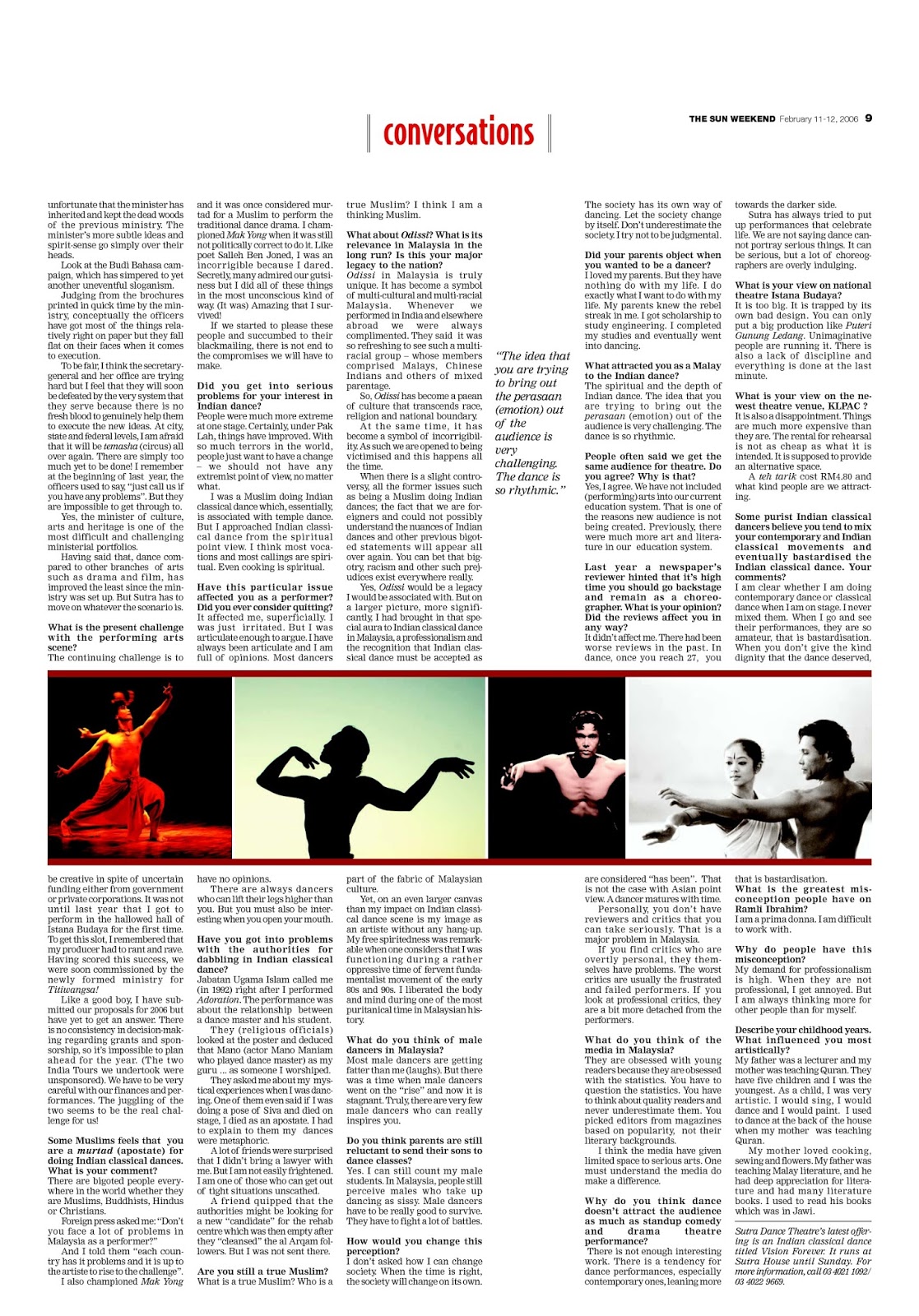
Ramli Ibrahim


Today I am highlighting an interview where it gives a glimpse of the dancing world in Malaysia. The interview appears in the sun dated Feb 10 2006

Title : In search of a sutra-ble audience

No male dancer has had as big an impact on the Malaysian dance scene as Ramli Ibrahim. He appeared on the public stage in 1983, and the same year, started the Sutra Dance Theatre. Now 53, Ramli has mesmerised audiences and dance critics for 22 years. He began with the Bharata Natyam and Odissi classical dance forms, but over the years, he has staged some provocative contemporary performances. For his contributions, he won the Boh Cameronian Lifetime Achieve-ment Award for 2003. But life has not always been a bed of roses for Ramli. Along with accolades, he has faced brickbats for taking the road less travelled. The iconic dancer takes Bissme S. on a journey into his life.

theSun: How has 2005 been for you?

It has been the most challenging year for us. Sutra produced several major works which successfully toured Malaysia, Singapore and India.
In India, we covered major cities such as Chennai, Mumbai and New Delhi among others.
Asia is the place to be! India, especially, is culturally one of the most interesting countries in the world. To be recognised as a major Indian classical dancer in India means a lot to me. Though, I think Malaysians are not aware of the extent of our success in India. We also produced Titiwangsa for Istana Budaya which was one of our major successes for 2005.
But, on a sad note, I lost my mother when I was in Bhubaneswar (India), right in the midst of our tour. She died on Sept 11 (aged 84).
We also lost our beloved Kak Endon (the prime minister's wife) shortly after, which was a devastating blow to Malaysian arts. She was a strong supporter of the arts. These two events are personally the saddest times of 2005 for me.

Did you cut your dance tour short in India to attend your mother's funeral?

No. I continued with my tour. I had made a commitment with the organiser and I couldn't back out. In fact when my father passed away in 1986, I also had to dance on stage. It's all about commitment.

You seem to be performing more in India lately. Have you lost the excitement of performing in Kuala Lumpur?

I feel that my presence as a performer is saturated in Kuala Lumpur. I feel that the creative juices and momentum offered by serious artistes can no longer be sustained by the relatively small audience in Kuala Lumpur alone. Our artistes are moving forward but their audiences are not able to catch up, both artistically and in numbers.
The majority have a limited concentration and they would rather go for leftover Broadway and West End musicals. This is why I feel that it is time Sutra ventures outside Malaysia and this is exactly what we aim to do in 2006. There will be more overseas tours for 2006. We are planning for Europe and America. Some of the cities we plan to cover are Toronto, Paris, France, Zurich and London.

What is your long-term plan?

For our long-term plan, we hope to secure Sutra's future by setting up a Sutra Foundation. This would be our ultimate gift and legacy to the nation. Sutra Foundation would continue our aspirations and catalytic work on Malaysian contemporary and traditional performing arts.

Do you have a successor to take over your role?

It would be folly to programme a successor for Sutra. We can't dictate destiny. In fact, there is at present no such serious talent with the essential leadership qualities in Sutra. We have good dancers but this is not sufficient. To lead Sutra one needs serious commitment, dedication and idealism. The present dancers are still too young and immature. I think to make real impact one needs to possess not just dancing talent, but a whole lot of other qualities. We can only provide the hotbed for talents and hope for the best.

What is your opinion of the Ministry of Arts, Culture and Heritage?

The minister has a lot of good visions and is very articulate. I am in full accord with the visions of our minister Datuk Seri Dr Rais Yatim but there is no exciting fresh blood in the ministry to execute the strategic changes that he envisions. So far we see only the same dead-pan bureaucratic zombies, completely uninterested in the arts except as a job. It is unfortunate that the minister has inherited and kept the dead woods of the previous ministry. The minister's more subtle ideas and spirit-sense go simply over their heads.
Look at the Budi Bahasa campaign, which has simpered to yet another bout of uneventful sloganism.
Judging from the brochures printed in quick time by the ministry, conceptually the officers have got most of the things relatively right on paper but they fall flat on their faces when it comes to execution.
To be fair, I think the secretary-general and her office are trying hard but I feel that they will soon be defeated by the very system that they serve because there is no fresh blood to genuinely help them to execute the new ideas. At city, state and federal levels, I am afraid that it will be temasha (circus) all over again. There are simply too much yet to be done! I remember at the beginning of last year, the officers used to say, "just call us if you have any problems". But they are impossible to get through to.
Yes, the minister of culture, arts and heritage is one of the most difficult and challenging ministerial portfolios.
Having said that, dance compared to other branches of arts such as drama and film, has improved the least since the ministry was set up. But Sutra has to move on whatever the scenario is.

What is the present challenge with the performing arts scene?

The continuing challenge is to be creative in spite of uncertain funding either from government or private corporations. It was not until last year that I got to perform in the hallowed hall of Istana Budaya for the first time. To get this slot, I remember that my producer had to rant and rave. Having scored this success, we were soon commissioned by the newly formed ministry for Titiwangsa!
Like a good boy, I have submitted our proposals for 2006 but have yet to get an answer. There is no consistency in decision-making regarding grants and sponsorship, so it's impossible to plan ahead for the year. (The two India Tours we undertook were unsponsored). We have to be very careful with our finances and performances. The juggling of the two seems to be the real challenge for us!

Some Muslims feel that you are a murtad (apostate) for doing Indian classical dances. What is your comment?

There are bigoted people everywhere in the world whether they are Muslims, Buddhists, Hindus or Christians.
The foreign press asked me: "Don't you face a lot of problems in Malaysia as a performer?" And I told them "each country has it problems and it is up to the artiste to rise to the challenge".
I also championed Mak Yong and it was once considered murtad for a Muslim to perform the traditional dance drama. I championed Mak Yong when it was still not politically correct to do it. Like poet Salleh Ben Joned, I was an incorrigible because I dared. Secretly, many admired our gutsiness but I did all of these things in the most unconscious kind of way. (It was) Amazing that I survived!
If we started to please these people and succumb to their blackmailing, there is not end to the compromises we will have to make.

Did you get into serious problems for your interest in Indian dance?

People were much more extreme at one stage. Certainly, under Pak Lah, things have improved. With so much terror in the world, people just want to have a change -- we should not have any extremist point of view, no matter what.
I was a Muslim doing Indian classical dance which, essentially, is associated with temple dance. But I approached Indian classical dance from the spiritual point view. I think most vocations and most callings are spiritual. Even cooking is spiritual.


Has this particular issue affected you as a performer? Did you ever consider quitting?

It affected me, superficially. I was just irritated. But I was articulate enough to argue. I have always been articulate and I am full of opinions. Most dancers have no opinions.
There are always dancers who can lift their legs higher than you can. But you must also be interesting when you open your mouth.

Have you got into problems with the authorities for dabbling in Indian classical dance?

Jabatan Ugama Islam called me (in 1992) right after I performed Adoration. The performance was about the relationship between a dance master and his student.
They (religious officials) looked at the poster and deduced that Mano (actor Mano Maniam who played the dance master) was my guru ... as someone I worshiped.
They asked me about my mystical experiences when I was dancing. One of them even said if I was doing a pose of Siva and died on stage, I died as an apostate. I had to explain to them my dances were metaphoric.
A lot of friends were surprised that I didn't bring a lawyer with me. But I am not easily frightened. I am one of those who can get out of tight situations unscathed.
A friend quipped that the authorities might be looking for a new "candidate" for the rehab centre which was then empty after they "cleansed" the Al Arqam followers. But I was not sent there.

Are you still a true Muslim?

What is a true Muslim? Who is a true Muslim? I think I am a thinking Muslim.

What about Odissi? What is its relevance in Malaysia in the long run? Is this your major legacy to the nation?

Odissi in Malaysia is truly unique. It has become a symbol of multi-cultural and multi-racial Malaysia. Whenever we performed in India and elsewhere abroad we were always complimented. They said it was so refreshing to see such a multi-racial group -- whose members comprised Malays, Chinese Indians and others of mixed parentage.
So, Odissi has become a paean of culture that transcends race, religion and national boundary. At the same time, it has become a symbol of incorrigibility. As such we are opened to being victimised and this happens all the time.
When there is a slight controversy, all the former issues such as being a Muslim doing Indian dances; the fact that we are foreigners and could not possibly understand the nuances of Indian dances and other previous bigoted statements will appear all over again. You can bet that bigotry, racism and other such prejudices exist everywhere really.
Yes, Odissi would be a legacy I would be associated with. But in the larger picture, more significantly, I had brought in that special aura to Indian classical dance in Malaysia, a professionalism and the recognition that Indian classical dance must be accepted as part of the fabric of Malaysian culture.
Yet, on an even larger canvas than my impact on Indian classical dance scene is my image as an artiste without any hang-up. My free-spiritedness was remarkable when one considers that I was functioning during a rather oppressive time of fervent fundamentalist movements of the early 80s and 90s. I liberated the body and mind during one of the most puritanical times in Malaysian history.

What do you think of male dancers in Malaysia?

Most male dancers are getting fatter than me (laughs). But there was a time when male dancers went on the "rise" and now it is stagnant. Truly, there are very few male dancers who can really inspire you.

Do you think parents are still reluctant to send their sons to dance classes?

Yes. I can still count my male students. In Malaysia, people still perceive males who take up dancing as sissy. Male dancers have to be really good to survive. They have to fight a lot of battles.

How would you change this perception?

I don't ask how I can change society. When the time is right, the society will change on its own. Society has its own way of dancing. Let the society change by itself. Don't underestimate society. I try not to be judgmental.

Did your parents object when you wanted to be a dancer?

I love my parents. But they have nothing do with my life. I do exactly what I want to do with my life. My parents knew the rebel streak in me. I got a scholarship to study engineering. I completed my studies and eventually went into dancing.

What attracted you as a Malay to the Indian dance?

The spiritual dimension and the depth of Indian dance. The idea that you are trying to bring out the perasaan (emotion) out of the audience is very challenging. The dance is so rhythmic.

People often say that the same familiar audience goes for theatre shows. Do you agree? Why is that?

Yes, I agree. We have not included (performing) arts into our current education system. That is one of the reasons a new audience is not being created. Previously, there were much more art and literature in our education system.

Last year a newspaper's reviewer hinted that it's high time you go backstage and remain as a choreographer. What is your opinion? Did the reviews affect you in any way?

It didn't affect me. There had been worse reviews in the past. In dance, once you reach 27, you are considered "has been". That is not the case with the Asian point of view. A dancer matures with time.
Personally, you don't have reviewers and critics that you can take seriously. That is a major problem in Malaysia.
If you find critics who are overly personal, they themselves have problems. The worst critics are usually the frustrated and failed performers. If you look at professional critics, they are a bit more detached from the performers.

What do you think of the media in Malaysia?

They are obsessed with young readers because they are obsessed with the statistics. You have to question the statistics. You have to think about quality readers and never underestimate them. You pick editors from magazines based on popularity, not their literary backgrounds.
I think the media have given limited space to serious arts. One must understand the media do make a difference.

Why do you think dance doesn't attract the audience as much as standup comedy and drama theatre performance?

There is not enough interesting work. There is a tendency for dance performances, especially contemporary ones, leaning more towards the darker side.
Sutra has always tried to put up performances that celebrate life. We are not saying dance cannot portray serious things. It can be serious, but a lot of choreographers are overly indulging.

What is your view on the national theatre Istana Budaya?

It is too big. It is trapped by its own bad design. You can only put a big production like Puteri Gunung Ledang. Unimaginative people are running it. There is also a lack of discipline and everything is done at the last minute.

What is your view on the newest theatre venue, KLPAC ?

It is also a disappointment. Things are much more expensive than they are elsewhere. The rental for rehearsal is not as cheap as intended. It is supposed to provide an alternative space.A teh tarik cost RM4.80 and what kind people are we attracting?

Some purist Indian classical dancers believe you tend to mix your contemporary and Indian classical movements and eventually bastardised the Indian classical dance. Your comments?

I am clear whether I am doing contemporary dance or classical dance when I am on stage. I never mix them. When I go and see their performances, they are so amateur, that is bastardisation. When you don't give the kind of dignity that the dance deserved, that is bastardisation.

What is the greatest misconception people have on Ramli Ibrahim?

I am a prima donna. I am difficult to work with.

Why do people have this misconception?

My demand for professionalism is high. When they are not professional, I get annoyed. But I am always thinking more for other people than for myself.

Describe your childhood years. What influenced you most artistically?

My father was a lecturer and my mother was teaching Quran. They had five children and I was the youngest. As a child, I was very artistic. I would sing, I would dance and I would paint. I used to dance at the back of the house when my mother was teaching Quran.
My mother loved cooking, sewing and flowers. My father was teaching Malay literature, and he had a deep appreciation for literature and had many literature books. I used to read his books which was in Jawi.

If you could change anything of your life, what will it be?

I would not waste my time in engineering . I would do painting. Even architecture and anthropology would have been a better choice

Why did you take engineering?

I was a product when the country wanted to produce doctors and engineers. I am not impressed with my students who says they get seven distinctions. I got seven distinctions when it was difficult (to get distinctions).
Now, it's much more simple to obtain distinctions and everyone is getting them. You can't speak a word of English, you still get seven distinctions. The youths are not curious enough. They don't have the kind of staying power we had, and everything is light, everything is easier

How do you like to be remembered?

Nothing. I don't want to be remembered. It is not important how I am remembered


Most dancers are afraid of getting older. Are you?

No.

Why not?

You don't realise your age is catching up. You only realised you can't do certain thing. If you can't accept your age, you have a problem

Some people say you can't retire and go behind stage. Is that true?

I am always behind the stage. I am the one who swept the floor when the show is over and everybody has left.

What is your advice to youngsters who are considering dance as their career?

Forget it. It is too difficult to survive unless you are strong.