Wednesday, March 23, 2016

Redha & Tunku Mona Riza


Today theSun featured my interview with film director  Tunku Mona Riza about her film Redha. Here is the full interview  

Headline : Giving Voice To Autism 
By Bissme S


The challenge of raising a child with autism is the main focus of the film, Redha, which opens in cinemas on April 14. 
The film focuses on six-year-old Danial, who is diagnosed with autism, and the difficulties his family faces trying to reach him and raise him in a world that does not understand him. 
Produced by Current Pictures Sdn Bhd at a budget of RM3.5 million, Redha is director Tunku Mona Riza’s first feature film. The 49-year-old mother of two teenagers had previously directed commercials and telemovies. 
Mona  first encountered an autistic child 20 years ago, when she went to a close friend’s house-warming party and was introduced to his five-year-old daughter. 
The little girl was aloof and completely ignored her. It was then that her friend told her that his daughter had autism and that she should not take offence to the child’s “unfriendliness”. 
Mona says: “I did not know what autism was all about then, so I did not ask my friend to explain.” 
In 2012, she was searching for material for her next telemovie and decided to focus on the subject of autism. She contacted her friend and they had a heart to-heart talk about his daughter and her condition. Her friend also introduced her to other parents raising children with autism. The more she talked to them, the more she was convinced the subject would be best depicted as a feature film rather than a telemovie. 
“With a feature film, you can reach a bigger audience than a telemovie,” she says. 
“I want Redha to be a movie that represents the voice of families with autistic children, and what they have gone through to bring them up. Almost all the scenes in Redha are based on true experiences.” 
However, she adds that her movie will not play like a documentary on autism.
“I just want to pique the audiences’ interest to find out more about autism on their own accord.” 

Redha features two child actors in the role of Danial. Harith Haziq plays the sixyear-old Danial for most of the film, while Izzy Reef plays a 13-year-old Danial later in the film. 
“I was very impressed with their auditions,” she says. 
“They were not shy.” 
Most of the conflict in the film comes from Danial’s father Razlan (played by actor Namron), who is devastated to learn that his son has autism, causing him to become distant from the child. 
The 47-year-old Namron, whose real name is Shahili Abdan, says: “As an actor, I always want to use my talent to change society for the better. I am glad to say Redha is giving me the chance to do that. The movie not only entertains you but also creates awareness about autism. It tells you that no child should be discriminated against. All children deserve to be loved and cared for.” 
Being a father of two young daughters helped him play Razlan more convincingly. 
“I could relate to the emotions that Razlan is going through [as a father],” he adds. 
The role also presented other challenges. Some of the major scenes in Redha take place on a beach in Terengganu’s Redang Island. Because some scenes called for his character to swim, Namron had to take swimming lessons before shooting began. 
The actor is also joined by his wife, June Lojong, in the film as his onscreen wife Alina. 
Namron had to act out some tender scenes with June. He recalls: “Initially, I felt awkward doing all the romantic scenes with my wife in front of the camera and the crew.” 
With time, he learned to put aside his embarrassment, and enacted the romantic scenes with June professionally as an actor rather than as her husband. 
Another key player in Redha is Nadiya Nisaa, 31, who plays Danial’s aunt Sasha. She is one of the few people who loves and cares for Danial without any prejudice. 
Nadiya is impressed with the amount of research Mona has done on autism before the start of the shoot. 
“She is passionate about this subject and if you watch the film, you can see her sincerity shine through,” says Nadiya, herself a mother of a five-year-old son, and who is also expecting her second child. “Before shooting the film, I had zero knowledge of autism. Now, it is a totally different story. I am sure the audience will go through the same emotions that I am going through.” 
Mona also made arrangement for Nadiya to meet with several parents with autistic children, which helped her get into the character of Sasha. 
“I really admire these parents,” she says. “It takes so much grace and patience to love their kids." 


The director on the set

a scene from Redha

Tuesday, March 15, 2016

Hanyut & U Wei


I met the well known film director U- Wei Saari at Chawan, Bangsar and asked the following questions. This interview was published in theSun today. Here is the full article  

Headline: Bleeding For His Art  
BY BISSME S. 

Award winning filmmaker U-Wei Saari has put his heart, soul and sweat into his latest masterpiece, Hanyut, an adaptation of Joseph Conrad’s 1895 debut novel Almayer s Folly. 
The story centres on Dutch trader Kasper Almayer living in colonial Malaya who dreams of finding a mythical gold mountain. He faces many enemies, including his own scheming wife, Mem. Starring Peter O’Brien, Diana Danielle, Sofia Jane, Adi Putra and Khalid Salleh, Hanyut (top) will open in cinemas at the end of this year. 
During a recent preview of a rough cut of Hanyut, UWei (below) answered some questions posted to him. 

* Hanyut has a budget of RM18 million. Some would say this is too much. 

Four years from now, everyone will say: ‘U-Wei was right, you need that amount of money to make an international film’. If you want a wedding dinner that [has good food], you have to pay for it. Same goes for movies. In the past, people said that my film Kaki Bakar (the first Malaysian movie shown at the Cannes Film Festival) was not a film because it was shot with a video camera. Now, many people are using video cameras to make films. 

*In all your films, your protagonists are always flawed. Why the fascination with flawed characters? 

“Angels are boring because they have no flaws. Angels are jealous of humans because humans have flaws. We have the choice to be good or to be bad. The best thing in life is to have choices.” 

*You like to feature bad marriages in all your movies. Any reason? 

“I am unlucky in that field (laugh). I write good bad marriages. Bad marriages give you drama, and a dysfunctional family is more interesting.” 

*What motivated you to turn Conrad’s novel into a movie? 

You cannot go wrong with a good book. Conrad’s not so condescending in the way he portrays us in his novel. It’s also interesting to see a white man afraid of a Malay woman. Conrad understands the mystery of a Malay woman. Men like to believe that they are smart and they can manipulate women. But in reality, women are the smarter ones, and they manipulate men.” 

*How faithful are you to the adaptation of this novel? 

The only thing you should be faithful to is to your wife and even that is very difficult for me. I believe in creative infidelity. I am not here to film his book. I am here to interpret it. When I made Jogho, I told the author (S. Othman Kelantan) that I cannot be faithful to [his works], and that his novel is just raw material to me. “In an interview, he jokingly said: ‘U-Wei is very clever and when he writes the script, he did not even see me’. But he likes the movie. I believe a filmmaker should not be intimidated by the author behind the book he is adapting.

* What do you feel when you watch Hanyut, again? 

I feel like throwing up. I try not to watch my movies after I have edited them. 

*So, you are not proud of Hanyut? 

“I am proud of all my works. But it hurts me whenever I watch my movies again. I wish I could have directed them better. “I always doubt myself [at every] creative moment. But doubt is good. Doubt makes you think. When you have doubt, you are not full of yourself.” 

*Your movies do well at international film festivals but never locally. 

I feel disappointed. I feel like Blanche DuBois in A Streetcar Named Desire. There is a famous line she said: ‘I have always depended on the kindness of strangers.’ I am the same. 
Her other favourite line is: ‘I don’t want realism. I want magic’. I want the same thing, too [for my movies].” 

*DuBois ends up in a mental hospital. Will you suffer the same fate? 

Sometimes, the Malaysian film industry can be like a mental institution – the haphazardness, the lack of infrastructure, and the regimented rules … We have campaigns like bring Malaysian movies to international cinemas and encourage filmmakers to think outside of the box. The clichéd taglines of these campaigns are not even fit to be written on a T-shirt.” 

*Why don’t you make more commercial movies? 

I want to hang on to my vision. I have to do the kind of movies I want to do. That is my curse. Of course, I get hurt a lot. But I survived. I can sleep easily. I do not suffer from bad dreams. Some make films because they want to tell the world they are filmmakers. That is why you see them rushing [around] making one film after another. I do not need that. I take my time to make movies. There are few things I want to say in my films. 

*What are some of them? 

Not all marriages are good. 

*Do you ever feel like quitting? 

I cannot give up because filmmaking is the only thing I know how to do. But there are times I’ve asked myself: ‘Why am I doing this? Am I a machoistic?’ Before I became a filmmaker, I only thought women bleed. Now I know I am wrong. Filmmakers bleed, too.

Tuesday, March 8, 2016

Train Station


Today, theSun featured my story on Train Station, a feature  that combines  40 filmmakers around 25 countries including two Malaysians,  Tony Pietra Arjuna and Isazaly Isa. Read the full story here  


Partners in Crime From left : Isazaly and Tiony 

Headline : A Real Global Effort
By Bissme S

They  say that too many cooks spoil the broth. But that does not seem to be the case at Detroit-based film production company CollabFeature. Its latest project, Train Station, which is currently making its rounds in several international film festivals, involved a total of 40 filmmakers from 25 countries taking turns at the helm. 
This film is likely to set a new Guinness World Record for the most directors in one film beating the current record holder, another CollabFeature project The Owner, which was helmed by 25 filmmakers. 
Train Station follows a single character, known only as ‘A Person in Brown’, as the character goes on a journey to major cities in the world such as Tehran, Berlin, Athens, Newcastle, Chicago, Dubai, Barcelona, Mumbai and even Kuala Lumpur. 
A Person in Brown is played by 40 actors of various ages, gender, ethnicity and sexual orientation in the 40 different segments of the film. Along the journey, the character is presented with choices that trigger different paths, giving us a universal story of fate, decisions and destiny. 
Among the 40 filmmakers involved in Train Station, two are Malaysians – Tony Pietra Arjuna and Isazaly Isa – who handled the Malaysian segment of the film. Tony is both producer and director while Isazaly is producer and co-writer. 
Recently, I was given a chance to watch the full movie. Initially, I thought I would get confused with the character switching from male to female and from one race to another. Thankfully, the film was easy to follow. 
The opening scene shows a man at a train station who learns that his train might not arrive because of a terrible accident down the line. As the movie progresses, some segments show the character deciding to wait for the train while other segments show the character leaving the station and heading for home. But each of the character’s choice and journey is filled with memorable events and people. In one scene, the character gets robbed

while walking home. In another, he enters his house and finds out his spouse is unfaithful. 
The Malaysian segment opens with A Person in Brown (played by actress Annie Too) at a riverbank. She has just killed her unfaithful husband and her lover. Their bodies are wrapped in black plastic bags, which she is trying to dump into the river. At another part of the river, she sees a man (Michael Chen) also dumping some black plastic bags in the river. Seeing her having difficulty with her bags, he comes to her aid. The man later asks her out for coffee at a restaurant. As the two of them begin to get comfortable, she spots a policeman walking into the restaurant.... 
The story for this segment is written by Isazaly, who first got involved in Train Station back in 2011. At the time, he was intrigued by CollabFeature’s setup after hearing about The Owner. 
He recalls: “I was curious how they 18 got so many directors from different parts of the world working together on one feature film through the internet and without meeting anyone face to face.” 
Isazaly visited CollabFeature’s website, and when he heard they were beginning work on Train Station, he pitched his story idea on a forum, which was later approved. Sadly, Isazaly had to pull out from the project. 
“I had pending deadlines for many other film projects,” he says. “I had also just become a father and I wanted to spend more time with my daughter.” His place was taken over by Tony, who was impressed by Isazaly’s initial story and decided to keep it, with a few minor tweaks. Isazaly says he is extremely pleased with the end result. 
Now, he and Tony are planning to have Train Station screened in Malaysia. As Tony explains, “if you want different cultures in one film, this is the one you have to see”

Scenes from Train Station ( Malaysian Segment) 


Wednesday, February 3, 2016

Munafik & Syamsul Yusof


Film maker Syamsul Yusof speaks to the Sun about his  latest horror movie Munafik. Here is the full story.

Headline: In His Father’s Footseps
By Bissme S

Syamsul Yusof has been directing since he was 19. The son of Malaysian renowned director Datuk Yusof Haslam made his directing debut for a TV series under his father’s production company, Skop Productions Sdn Bhd.
Three years later, he directed his first feature film, Evolusi KL Drift, which collected RM3 million at the box office. Since then, the 31-year-old has helmed nine films, two of which earned him the best director award at the Malaysian Film Festival, the first in 2010 for Evolusi Kl Drift 2, and the second in 2011 for KL Gangster. His latest effort is the horror, Munafik (above), which has a lot of of Islamic elements. It opens in cinemas on Feb 25.
“The holy Al Quran was one of my main references when I wrote the script,” says Syamsul.
“I spoke to many ustaz (religious scholars) before making this film. I did not want to cross any religious boundaries that may offend anyone.”
Munafik centres on Adam, an Islamic medical practitioner, who is having a difficult time coming to terms with his wife’s death. A woman named Maria believes she is being possessed by something sinister and begs him to help her. But Adam doesn’t realise that the spirit haunting Maria will also attack him. Syamsul  also takes on the role of Adam, while actress Nabila Huda plays Maria. Others in the cast include Fizz Fairuz, Pekin Ibrahim, Datuk Rahim Razali and A. Galak.
“I gave Nabila a tough time on set, but she rose to the occasion,” he says.
“Her performance will dazzle you.”
Munafik is Syamsul’s second horror movie after the 2012 Khurafat, which became a box-office hit, with takings of more than RM8 million. The trailer of Munafik looks frightening enough to ensure another success for Syamsul.
“I believe that the recipe for a good horror movie is to pay attention to the script,” he says.
“Most young filmmakers neglect the script, and put more attention in creating scary and suspenseful moments.”
Syamsul cited horror movies such as Thailand’s Nang Nak and Shutter, which have solid scripts. As for hitting box-office success, Syamsul spoke of his bitter experience with his previous film, KL Gangster 2. Before the film opened in cinemas, pirated copies of the movie were already selling in the streets.
“KL Gangster made just over RM11 million, while KL Gangster 2 only made RM5 million,” he says. “I am sure KL Gangster 2 would have made more money if not for the piracy. I worked very hard on my film. [And] someone just came along and copied my film, and made a lot of money from it. I did not get anything from the pirated copies. I felt frustrated. I almost wanted to quit making films. But I could not bring myself to do it, as making films is in my blood.”
At 15, Syamsul already knew he wanted to be a filmmaker just like his famous father.
“Most people assume my road to becoming a filmmaker was easy because [of my father],” he says. “Well, they are wrong. When I started my career, I had actors who disrespected me on the set. I had critics who doubted me. But if you want to be successful in your field, you have to develop a thick skin, and learn to ignore your critics.
“If you are in the film business, you will always have to face the critics. Even great films like Avatar have critics. You cannot impress everyone.”
What does his famous father think of him as a filmmaker? With a laugh, he says: “My father has never praised me. He is my fiercest critic. Strangely enough, behind my back, my father will say great things about me and my films to his friends.
 “When I met [those people], they would tell me how my father is very proud of me, but I had a hard time believing them.
“Now I am older and I understand my father’s motivation better. He criticises me because he wants me to improve my skills as a director. He does not want me to be complacent with my success.”

Scenes from Munafik 


Tuesday, February 2, 2016

A Review on OlaBola


Today, theSun runs a review on OlaBola Here is the full story 

  
THE STORY starts in the present time with a young professional broadcast journalist (Marianne Tan) who is disillusioned with life in Malaysia and prepares to head for greener pastures in England. She is given a final assignment: to do a story about a multicultural team of footballers who are trying to overcome the odds and their personal problems to achieve international Olympic glory. The film goes back to 1980s and focuses on three individuals in the team – team captain Chow Kwok Keong (Chee), striker Ahmad Ali (Luqman), and goalkeeper Muthu Kumar (Saran). Chow is torn between giving his family a better life and his passion for football. Muthu faces objections from his father over his fascination with football and Ahmad wants to be the best player in his team, but has p r o b l e m controlling his temper. I am sure director Chiu is feeling some pressure.
Two years ago, he delivered the touching The Journey, which went on to break box-office record as the then highest-grossing Malaysian film, collecting more than RM17 million. (That record has since been broken by Polis Evo last year.) Now, everyone is expecting him to recapture the magic with OlaBola. I am sure most of them are going to make comparisons between the two films. Well, I will try not to succumb to temptation, and instead judge OlaBola on its own merits.
For starters the movie was well shot. The cinematography was beautiful. The football matches were intense, and will have audiences at the edge of the seats. Chiu has managed to capture era magnificently. A lot of attention has been put on the costumes and the set. The actors also gave convincing performances including the new ones like Chee, Luqman and Saran. Sometimes, new actors have a tendency to look awkward on the screen. This did not happen here. Yet, OlaBola is far from perfect.

The biggest flaw I felt lies in the script and dialogue. The message of unity among different races and the ultimate love these characters have for their country is continuously drummed into the audience. These messages of patriotism can be overwhelming and at times, a little irritating, and could have been delivered in a more subtle way. While Chiu has given us a very sweet cake of a movie, what it badly needs is a little bitterness to cut down on that overt sweetness.

The Look of Silence


theSun got Joshua Oppenheimer to talk about his documentary The Look of Silence that is being nominated for an Oscar for Best Documentary feature.  Here is the full interview 

Headline: A Festering Wound   
By Bissme S

Director Joshua Oppenheimer and his team opened the world’s eyes to the genocide that took place in Indonesia from 1965 to 1966 in their 2013 landmark Academy Award-nominated The Act of Killing. The documentary highlighted the large-scale killings in Indonesia that targeted communists, ethnic Chinese, and alleged leftists. It is estimated that 500,000 people were killed. The purge was a pivotal event in the elimination of the Indonesian Communist Party (PKI) as a political force, the downfall of then-president Sukarno, and the rise of Suharto as the second president of Indonesia.
Oppenheimer and his team have since followed up that story with a second documentary The Look of Silence, which showed what it is like for those who survived the genocide. The Look of Silence has already won awards at international film festivals in Berlin and Venice, and has given the director his second Academy Award nomination for best documentary feature.
This documentary focuses on Adi Rukun an optometrist who was born after the genocide. Yet, he is haunted by the fact that his brother Ramli was murdered during the brutal event. His mother cannot come to terms with Ramli’s death. What makes her pain unbearable is that the men who carried out the killing are still free.
With the help of Oppenheimer and his team, Adi is able to confront the men who killed his brother. He had hoped to see some regret and remorse in their eyes. Instead, most of them try to justify their actions. The Look of Silence is a compelling, intense and heartbreaking documentary of the pain that still festers in the heart of those left behind.
The scene where a mother laments her son’s death, and hopes that the killers and their descendants will lead horrible lives is heart-rending. Another touching scene is when a daughter of the one of the killers pleads with Adi to forgive her old and sick father, and to let bygones be bygones.
This is indeed a well-made documentary that deserved its Oscar nomination. In an interview with theSun, Oppenheimer says: “It is incredibly humbling to be nominated, again. We could not have made this film without our anonymous Indonesian crew, and our gentle protagonist Adi, who risked their lives to share their story.
“The genocide began years ago. But it hasn’t ended for the survivors because the perpetrators are still in power, and millions are still living in fear. The Look of Silence helped Indonesians express their yearning for truth, justice, and reconciliation.”
The documentary also features the risks undertaken by the team and by Adi during the course of filming. In the scenes where Adi confronts the murderers of his brother at their residence, there is a palpable sense of danger in the air and fear for Adi’s safety.
“These confrontations could have been dangerous,” Oppenheimer says, explaining how they had to take many precautions to prevent any untoward incidents. When he met with the perpetrators, he only brought along Adi and a small crew.
“Adi would come with no identification card,” he says.
“All of us would empty all the numbers from our handphones and bring a second car so that [we could switch vehicles] minutes after leaving their houses, making it harder for the perpetrators to follow us.”
Oppenheimer is thankful that none of the confrontations ended violently. He feels the reason for that was because of Adi’s patience and empathy with his brother’s killers, and the fact that the perpetrators were not quite sure how to react to the confrontation.
“I was aware Adi would not get any apology from them and I did not hide this fact from him,” Oppenheimer said. “But I told Adi that by documenting the perpetrators’ inability to apologise, maybe we could show how torn the social fabric of Indonesia is.”
Oppenheimer believes that if he could film their complex reactions of fear and guilt at being visited by their victim’s brother, then perhaps, he could shed a light on how these feelings represent the divide between Indonesians and their own past, and from each other.

As to the possibility of making feature films, Oppenheimer has no plans to do so. “Non-fiction filmmaking is my way of working with real people to create occasions in which the mysteries of being become palpable,” he says. “Why would I want to give this up?”

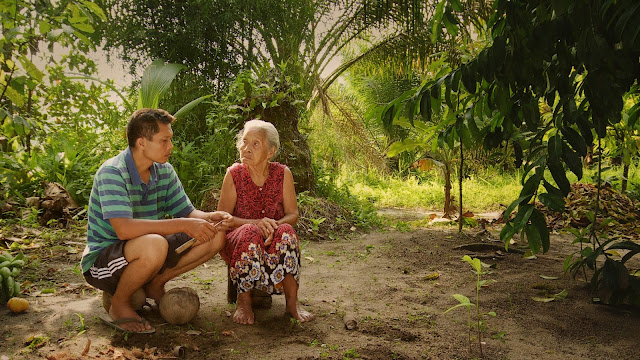
Adi and his mother talking about the past

Monday, February 1, 2016

Yellow Boat Of Hope


I am highlighting a feature story where some children had to swim their way to school to get an education. This article was published in theSun today.  

Headline : The Yellow School Boat
By Bissme S

Going to school was not easy for the children of Zamboanga City in the Philippine district of Mindanao. Up to 2010, they had to literally cross the river on foot with their schoolbag,  that contained not only their books but also their school uniform and shoes, over their heads to get to school. Once they reached the other side, they had to change out of their wet clothes into their uniform and shoes, and put the wet clothes wrapped in a plastic bag into their schoolbag. And they had to do this every day to and from school.
When philanthropist Jay Jaboneta (below) first visited this community, he was impressed by the children’s determination to get an education despite all the obstacles they had to face. He posted their story in his Facebook and it created some interesting discussion between him and his friends. They then decided to collect money and buy a boat that could ferry these children to and from school so that the children would no longer get wet going to school.
Jay had the boat painted yellow (bottom) because he wanted the boat to resemble the colour of the yellow schoolbus that one sees in movies.
“Both of them have the same function,” he says.
“Their aim is getting the children to school. The only difference is that one travels on the road and the other travels on water. Yellow is also the colour of hope.”
Their contribution did not end with one boat for one community. Jay and his friends went on to create the Yellow Boat of Hope Foundation, and over the last five years, the foundation has presented some 2,000 of these yellow boats to more than 50 communities in the Philippines.
“One story that truly touched me was [about this] boy who was placed second in his class … but since [getting the boat to go] to school, he [is now the top student] in his class,” says Jay.
 “We never imagined that one day, a single Facebook status and a single yellow boat would launch thousands of [such] boats and even inspired other organisations to start their own school boat projects.”
Jay firmly believes that every individual can make positive changes in society.
“The great thing a little lamp can do which the big sun cannot is to give light at night,” he says.
“It shows no one is superior by size. If we cannot do great things, we can do small things in a great way. “In my eyes, all our volunteers in the yellow boat [project] are ordinary heroes who strive to make a difference in their specific communities.”
 The foundation has since building classrooms, schools and dormitories for those children who not only have a hard time getting to school but are also studying in dilapidated classrooms or even under a tree! As Jay says, they want to create a comfortable environment for these students to study in comfort.
 For him, the biggest challenge he faced running the foundation is raising the funds needed to help all the needy communities.
“Our approach is volunteer driven and it is also quite hard to find local volunteers who can implement our projects on the ground. We are looking at raising enough funds to pay people to work for us and make our work more sustainable.”
 Jay says there are 7,107 islands in the Philippines and the Department of Education has identified more than 1,000 communities where children may need either boats or other forms of transport such as bicycles to get to school.
“I believe it was Nelson Mandela who said education is the best weapon which you can use to change the world,” says Jay.
“Education allows those who live at the bottom of the economic pyramid to gain access to opportunities so that they can provide for themselves and their families. It is our undying hope that one day there will be no child left behind and all children of school going age who want to go to school are in school.”

For more, go to http:// yellowboat.org/

Going to school without getting wet 

Children has to swim to school